








Across industries, visual data has become a core input for automation, analytics, and decision-making. Whether in industrial inspection, medical diagnostics, security monitoring, or AI-driven vision systems, the demand is clear: higher image quality, faster data transfer, and reliable integration.
The 3.0 Camera Module, typically based on USB 3.0 or equivalent high-speed interfaces, addresses these demands by enabling rapid image transmission without sacrificing resolution or stability. For manufacturers and system integrators, this class of camera module strikes a critical balance between performance, flexibility, and cost. Companies such as ELP have focused on refining 3.0 camera module solutions to meet real-world engineering requirements.
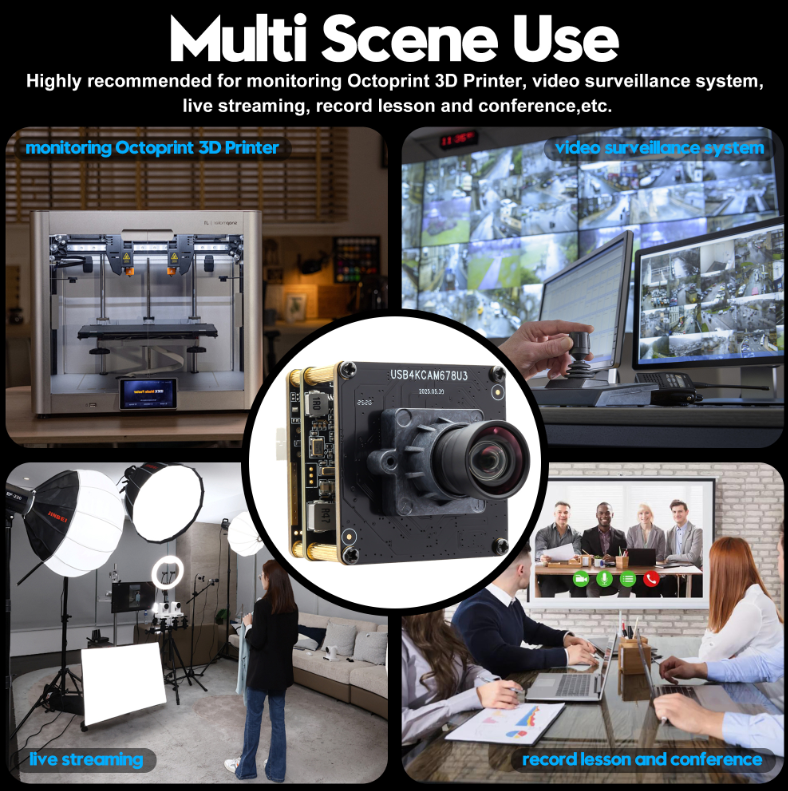
What Is a 3.0 Camera Module?
A 3.0 Camera Module is a high-speed imaging module designed to capture and transmit image data via a USB 3.0 interface or similar high-bandwidth connection. Compared to earlier-generation camera modules, it offers significantly higher data throughput, enabling:
-
Higher resolutions
-
Increased frame rates
-
Lower latency
-
Improved real-time performance
This makes 3.0 camera modules especially suitable for applications where image clarity and responsiveness are critical.
Core Technical Advantages of 3.0 Camera Modules
High-Bandwidth Data Transmission
USB 3.0 provides a theoretical bandwidth of up to 5 Gbps, allowing large image data streams to be transferred efficiently. This capability supports:
-
Full HD and multi-megapixel sensors
-
High frame rate video capture
-
Simultaneous image processing and streaming
For vision systems that rely on real-time feedback, bandwidth is a decisive factor.
Improved Image Stability and Signal Integrity
Modern 3.0 camera modules are designed with optimized signal paths and shielding to reduce interference. This ensures:
-
Stable image output
-
Reduced data loss
-
Consistent performance during continuous operation
ELP emphasizes signal reliability in its camera module designs to support long-duration industrial and commercial use.
Sensor Flexibility and Optical Compatibility
One of the strengths of the 3.0 camera module platform is its sensor adaptability. Depending on the application, modules can be configured with:
-
CMOS sensors of varying resolutions
-
Global or rolling shutter options
-
Different pixel sizes for low-light or high-speed imaging
Additionally, compatibility with multiple lens mounts allows engineers to tailor field of view, depth of field, and focal length to specific use cases.
Key Application Scenarios
Industrial Vision and Inspection
In automated production lines, 3.0 camera modules enable high-speed image acquisition for:
-
Defect detection
-
Dimensional measurement
-
Barcode and code reading
The combination of speed and resolution improves inspection accuracy without slowing down production.
Medical and Laboratory Imaging
Medical devices and laboratory instruments benefit from:
Clear image capture
Low-latency data transmission
Compact module integration
These characteristics support diagnostic accuracy and real-time visualization.
AI and Embedded Vision Systems
AI-based vision systems require fast data transfer to feed algorithms. 3.0 camera modules provide the throughput necessary for:
-
Object recognition
-
Facial analysis
-
Behavioral monitoring
ELP camera modules are often integrated into embedded platforms for edge computing applications.
Security and Monitoring
For surveillance and monitoring systems, high frame rates and resolution help capture critical details, even in dynamic environments.
Why Choose 3.0 Camera Modules from ELP?
ELP brings a practical engineering approach to camera module development, emphasizing:
-
Stable high-speed data transmission
-
Flexible sensor and lens options
-
Consistent manufacturing quality
-
Support for diverse application needs
Rather than focusing solely on specifications, ELP designs 3.0 camera modules to perform reliably in real-world systems.
Conclusion: A Foundation for High-Performance Vision Systems
As imaging applications continue to evolve, the need for speed, clarity, and integration efficiency becomes more critical. The 3.0 Camera Module provides a robust foundation for modern vision systems across industries.
By combining high-bandwidth interfaces, sensor flexibility, and reliable design, 3.0 camera modules—such as those developed by ELP—enable engineers to build smarter, faster, and more responsive imaging solutions.
https://www.hdusbcameras.com/exploring-the-future-of-imaging-the-role-of-3-0-camera-modules.html
Comments (0)