









In modern diagnostics, biotechnology, and life-science research, accuracy is everything. As microplate-based assays continue to dominate laboratories worldwide, the performance of a Microplate Washer—an essential companion to the Microplate Reader—has become increasingly important. Designed to wash enzymatic plates after detection, the microplate washer ensures measurement accuracy, experiment reproducibility, and reliable assay performance. Zhenxin, a manufacturer committed to delivering dependable analytical instrumentation, provides high-quality Microplate Washers engineered for medical, biochemical, and refined chemistry applications.
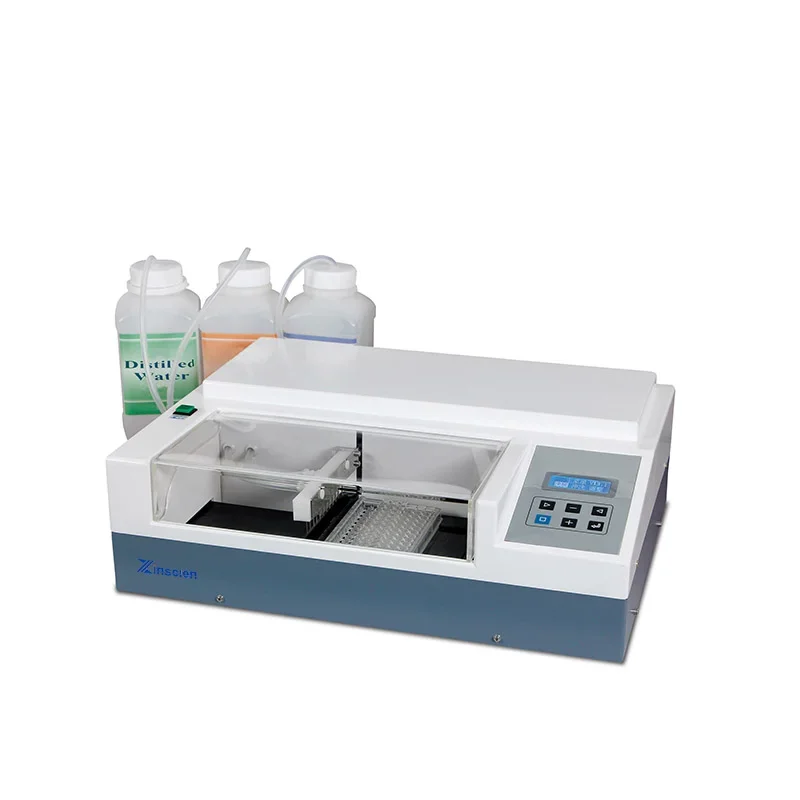
Understanding the Microplate Washer: More Than Just an Accessory
Although frequently described as an “accessory” to the Microplate Reader, the Microplate Washer is a core analytical tool in its own right. Its primary tasks include:
1. Automated Plate Washing
Microplate Washers perform repeated cycles of aspiration, dispensing, and soaking to remove unbound substances in assays such as:
ELISA (Enzyme-Linked Immunosorbent Assay)
Cell-based assays
Protein quantification experiments
Immunological reaction tests
A clean, uniformly washed plate ensures that the Microplate Reader receives accurate optical signals.
2. Residual Removal and Cross-Contamination Prevention
By removing residual reagents, the washer minimizes:
Background noise
Non-specific binding
Erroneous optical readings
This improves both signal-to-noise ratio and assay reliability.
3. Reagent Dispensing in Various Scientific Fields
While widely used in medical diagnostics, the Microplate Washer is also applied in:
Refined chemical analysis
Pharmaceutical research
Biochemical experimentation
Food inspection laboratories
Environmental monitoring
In these fields, consistent washing and precise reagent distribution are essential for reproducible data.
Why Microplate Washing Matters in ELISA and Similar Assays
ELISA and immunoassays depend on antigen-antibody interactions. Any unbound or non-reacted molecules that remain on the plate surface can disrupt results. The Microplate Washer ensures:
• Uniform washing across all wells
Uneven washing leads to inconsistent color development and unreliable absorbance readings.
• Gentle handling of the sample
High-precision vacuum and pressure controls prevent:
Cell layer disruption
Well scratching
Sample loss
• Better reproducibility for high-throughput laboratories
Automation dramatically reduces manual errors, ensuring standardized processing from plate to plate.
Key Technical Features of High-Quality Microplate Washers
1. Multi-Channel Aspiration and Dispensing
Modern washers use:
Eight-channel
Twelve-channel
Or 96-well simultaneous modes
This ensures fast, uniform cleaning.
2. Adjustable Parameters for Experimental Flexibility
Essential adjustable settings include:
Dispense volume
Aspiration strength
Soaking time
Wash cycle frequency
Plate compatibility (U-bottom, V-bottom, flat-bottom)
These features allow optimization for complex assay requirements.
3. Anti-Clogging and Precision Nozzle Design
Innovative nozzle engineering prevents blockage, ensures even reagent distribution, and reduces maintenance frequency.
4. High Chemical Resistance
Because washers handle buffers, detergents, enzymes, and organic reagents, materials must withstand corrosion and chemical stress.
Zhenxin uses chemically resistant tubing and precision components to ensure long-term reliability.
5. Residual Volume Minimization
At the end of each cycle, minimal liquid should remain in the wells.
This improves:
Background reduction
Sensitivity of detection
ELISA accuracy
6. Automated Self-Cleaning Mechanisms
Many washers integrate:
Internal flushing programs
Waste management systems
Decontamination routines
These reduce contamination risks and simplify maintenance workflows.
Zhenxin Microplate Washer: Reliable Performance for Demanding Laboratories
As laboratories shift further toward high-throughput and automated workflows, the need for stable, accurate plate washing grows. Zhenxin designs Microplate Washers with several core strengths:
1. Optimized Washing Mechanism
Zhenxin’s washers maintain:
Precise aspiration alignment
Uniform dispensing
Adjustable washing intensity
Compatibility with various assay plates
This allows consistent results even in sensitive ELISA or kinetic assays.
2. Intelligent Controls and User-Friendly Interface
The interface enables quick configuration of:
Wash cycles
Soak times
Dispense volumes
Plate type selections
Technicians at different skill levels can operate the system efficiently.
3. High Durability and Stable Operation
Using industrial-grade components ensures stability during long testing periods, reducing the risk of drift, blockage, or inconsistent aspiration.
4. Cross-Industry Application Versatility
Zhenxin Microplate Washers are widely compatible with workflows in:
Hospital and clinical diagnostics
Biochemical testing labs
Pharmaceutical development
Academic research centers
Food safety and environmental analysis
Where precision matters, Zhenxin provides reliable support.
Choosing the Right Microplate Washer for Your Laboratory
When selecting a washer, laboratories should evaluate:
1. Plate Format Compatibility
Ensure the washer supports 96-, 48-, or 384-well plates depending on workflow.
2. Washing Performance
Check whether the instrument offers:
Consistent aspiration depth
Fast liquid dispensing
Low residual volumes
3. Customization Options
Different assays require different fluid dynamics. Adjustable parameters ensure flexibility across experiments.
4. Maintenance and Cleaning Simplicity
Key considerations include:
Anti-clogging design
Self-cleaning modes
Easy replacement of tubing or nozzles
5. After-Sales Support
Zhenxin provides technical support, training assistance, and long-term service for global laboratories.
Conclusion
A Microplate Washer may appear secondary to the Microplate Reader, but in practice, it is a crucial determinant of experimental accuracy. Inconsistent washing results in unreliable data, repeat tests, and wasted reagents—all of which increase operational costs.
By ensuring precise washing, controlled aspiration, and uniform reagent distribution, modern Microplate Washers enhance the quality of ELISA, biochemical assays, pharmaceutical screening, and many other analytical methods.
With its commitment to precision engineering and laboratory reliability, Zhenxin provides high-performance Microplate Washers that support scientific integrity and efficient workflows. For laboratories seeking dependable washing results and long-term operational stability, a well-designed microplate washer is not optional—it is essential.
Comments (0)