








In modern railroad infrastructure, the integrity of the permanent way relies heavily on the performance of its continuity components. While continuous welded rail (CWR) dominates high-speed corridors, jointed track remains indispensable in heavy-haul freight lines, industrial spurs, transit networks, and areas prone to extreme thermal expansion. At the heart of these critical connections is the railway fish plate—alternatively designated as a rail joint bar or splice bar.
A high-quality railway fish plate is a mechanical metal joint bar engineered to connect the ends of two rails, bonding them into a continuous, load-bearing structure. Far from being a simple piece of punched steel, the modern fish plate is a highly engineered component designed to mitigate dynamic forces, absorb impact loading, and guarantee long-term railroad transportation safety across both light-rail transit and heavy-haul freight systems.
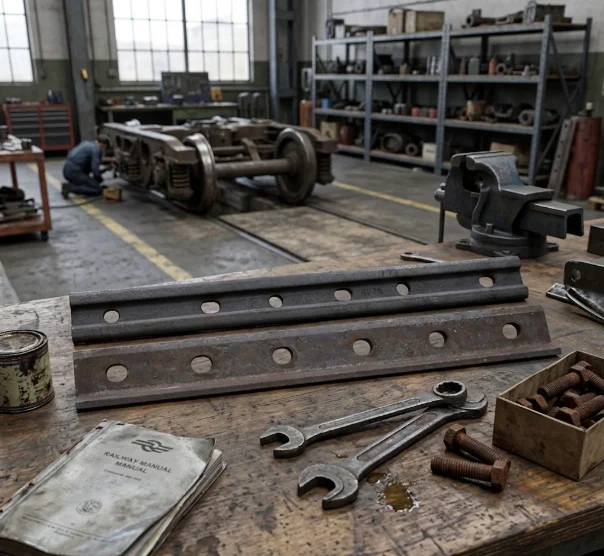
1. Dynamic Load Distribution and the Mechanics of Wheel-Rail Impact
When a train transitions over a rail joint, the discontinuity in the running surface creates severe dynamic wheel-rail impact forces. This phenomenon, often referred to as the "joint impact," accelerates ballast degradation, induces structural fatigue in the rail ends, and compromises ride quality.
A premium-grade railway fish plate drastically reduces the impact of wheels on these jointing sections. From an engineering standpoint, the fish plate acts as a bridge that maintains vertical and lateral alignment under intense wheel loads. By transferring the bending moments and shear forces smoothly from the running rail to the receiving rail, the joint bar preserves the continuity and steadiness of the train.
Without mathematically precise fitment and optimal metallurgical properties, a substandard fish plate allows for structural deflection at the joint. This vertical deflection creates a stepped joint, which exponentially increases dynamic impact loads, leading to bolt hole cracking, rail seat abrasion, and catastrophic structural failure.
2. Advanced Metallurgy and Structural Integrity in Joint Bar Manufacturing
To withstand millions of gross tons (MGT) of traffic, industrial joint bars must exhibit exceptional tensile strength, yield strength, and fatigue resistance. At HuiBo Railway, manufacturing standards transcend basic structural steel casting. Modern heavy-haul and light-rail fish plates are forged or rolled from high-quality medium-carbon or alloy steel, undergoing rigorous heat treatment processes to achieve an optimal balance between hardness and fracture toughness.
The microstructural uniformity of the steel ensures that the joint bar can endure cyclic loading without developing micro-cracks. For infrastructure operating in challenging environments—such as coastal freight routes or chemical transport lines—corrosion-resistant coatings or specialized polyurethane-insulated materials are utilized to provide both structural bonding and electrical isolation for signaling circuits.
3. Classifications and Application Specifics: From Light Rail to Heavy Haul
Rail networks are highly diverse, requiring distinct joint bar geometries and configurations to match specific rail profiles (such as UIC60, 115RE, or 136RE).
Standard Mechanical Fish Plates
Utilized primarily in traditional jointed tracks, these bars rely on a four- or six-hole configuration. They are engineered with a specific clearance to allow for thermal expansion and contraction of the rail steel while maintaining strict lateral alignment.
Compromise Joint Bars
When infrastructure upgrades require the connection of two different rail sections (e.g., transitioning from a 90 lb rail to a 115 lb rail), standard plates cannot be used. Compromise fish plates are step-machined with absolute precision to align different rail heights and head widths perfectly, preventing stepped joints and minimizing wheel impact.
Insulated Rail Joints (IRJ)
Crucial for modern signaling systems and track circuits, insulated fish plates are bonded with high-performance epoxy and encapsulated in fiberglass or polyurethane. They provide the necessary mechanical strength to bond the rails while completely blocking electrical current, a vital feature for automated train control and safety interlocking mechanisms.
4. Mitigating Failure Modes through Strategic Procurement
Track maintenance engineers frequently combat joint degradation, which accounts for a significant portion of track maintenance budgets. Common failure modes include:
-
Fatigue Cracking at the Bolt Holes: Induced by tensile stresses during joint deflection.
-
Fish Plate Cracking from the Top Center: Caused by high tensile stress in the upper fishing surface under negative bending moments.
-
Mechanical Wear on the Fishing Surfaces: Resulting in loose joints and accelerated rail-end batter.
Partnering with an experienced component manufacturer like HuiBo Railway allows engineering procurement teams to mitigate these risks. By utilizing precision-machined fishing angles that match the exact contour of the rail head and base, HuiBo Railway joint bars optimize the fitment areas. This precise engineering ensures uniform stress distribution, prevents localized stress concentration, and extends both the lifespan of the joint bar and the rail itself.
5. Precision Installation and Maintenance Protocols
Even the highest-quality heavy-haul joint bar will fail prematurely if improper installation protocols are followed. Achieving absolute railroad transportation safety requires strict adherence to maintenance standards:
-
Torque Management: Track bolts must be tightened using calibrated torque wrenches to exact specifications. Under-tightening leads to joint loosening and excessive movement, while over-tightening restricts thermal expansion, risking track buckles or pull-aparts.
-
Fishing Surface Lubrication: Regular application of high-pressure, graphite-based lubricants reduces friction and wear between the rail and the fish plate, facilitating smooth thermal movement.
-
Regular Non-Destructive Testing (NDT): Ultrasonic testing and magnetic particle inspection should be deployed periodically at jointing sections to detect sub-surface fatigue cracks before they propagate into critical failures.
Conclusion: Securing the Future of Rail Infrastructure
The reliability of a rail network is only as strong as its weakest joint. Investing in premium railway fish plates is a direct strategy for reducing operational downtime, lowering track maintenance costs, and ensuring uninterrupted transit safety. For global railway procurement managers and engineering contractors, selecting components that meet precise international standards (such as AREMA, BS, UIC, or DIN) is paramount.
As a trusted partner in global transit infrastructure, HuiBo Railway delivers high-precision, high-durability rail joint solutions engineered to withstand the harshest mechanical demands. Protect your infrastructure assets, optimize track uptime, and guarantee absolute transit safety by specifying premium joint bars engineered for the long haul.
Comments (0)