









In the field of geological exploration, the selection of drilling tools directly determines the quality of core samples, the efficiency of the operation, and ultimately the reliability of subsurface data. Among the various diamond core bits available, surface set core bits occupy a distinct and enduring position. They are not a universal solution, but in the right formations, they deliver performance that is difficult to match at comparable cost.
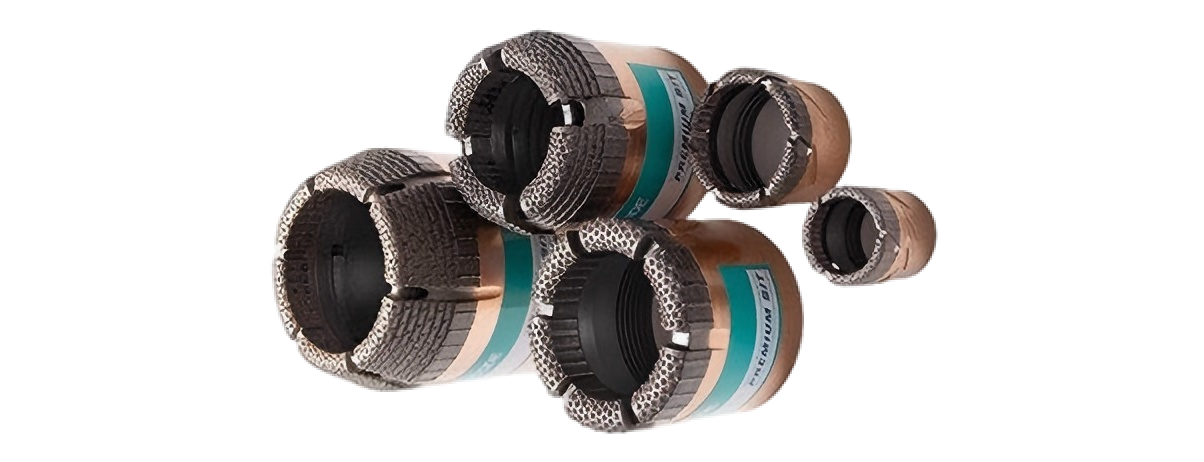
What Are Surface Set Core Bits?
A surface set core bit is constructed with a single layer of industrial-grade diamonds—either natural or synthetic—embedded into the cutting face of a metal matrix crown. Unlike impregnated diamond bits, where diamond particles are distributed throughout the matrix and self-sharpen as the matrix wears, surface set bits rely on the exposed diamond layer to cut the rock directly. This design gives them a characteristic cutting action that is closer to ploughing or scratching than grinding.
The matrix itself is typically a hard tungsten carbide compound, chosen to resist abrasion while supporting the diamond layer. Waterways are machined into the crown to allow drilling fluid to cool the bit face and flush cuttings away. The geometry of these waterways, combined with the crown profile, significantly influences how the bit performs in different ground conditions.
Surface set bits are primarily recommended for drilling relatively soft to medium-hard formations. They can also be used in harder ground when available rotational speed and bit load are insufficient for impregnated bits to function effectively. However, they are generally not suitable for broken or loose formations, where the single-layer design is prone to premature failure.[1]
Selecting the Right Surface Set Bit
Choosing an appropriate surface set core bit requires attention to three primary variables: diamond size, diamond grade, and crown profile.
Diamond size is expressed in stones per carat (SPC). The general principle is straightforward: the harder the rock, the smaller the diamond size should be. For soft formations, larger stones (10/15 SPC) provide aggressive cutting and fast penetration. For medium to hard rock, smaller stones (40/60 SPC or finer) are necessary to maintain cutting efficiency and prevent diamond fracture. Using oversized diamonds in hard rock results in rapid diamond loss and poor penetration.
Diamond grade refers to the quality and toughness of the stones. Higher-grade natural diamonds withstand greater loads and resist fracturing in hard, competent formations. Synthetic diamonds offer a more economical alternative for softer ground where extreme toughness is not required. The grade selection should align with both the rock hardness and the abrasiveness of the formation.
Crown profile determines how the bit interacts with the rock and how stable it remains during drilling. Common profiles include:
-
Semi-round: The standard profile, offering good stability across a range of ground conditions. It is robust in hard, fractured formations but requires adequate bit load to achieve fast penetration.
-
Stepped: Designed for higher penetration rates, particularly in wireline systems. The stepped geometry increases cutting efficiency but is more fragile in fractured ground.
-
Pilot: Provides good stabilization and core recovery in soft to medium formations. The extended nose helps center the bit and protect the core sample.
-
Face discharge: Incorporates additional flushing ports to minimize core wash in soft, fragile ground where sample integrity is critical.
The correct combination of these parameters can only be determined with knowledge of the specific geological conditions. A bit that works well in one project may underperform in another if the ground characteristics differ.
The Role of Drilling Parameters
Even the best-designed bit will fail if operated outside its intended parameter window. For surface set bits, weight on bit (WOB), rotational speed (RPM), and flushing rate must be balanced carefully.
Excessive WOB can fracture diamonds or overload the matrix, especially in hard formations where the single-layer design has limited impact resistance. Insufficient WOB leads to polishing—where diamonds glaze over and stop cutting effectively. RPM must be matched to the bit diameter and ground conditions; higher speeds improve penetration in soft rock but increase heat generation and vibration in hard ground.
Flushing is equally critical. Inadequate fluid flow allows cuttings to accumulate at the bit face, causing regrinding, overheating, and premature wear. Excessive flow can erode soft formations and disturb the core sample. The optimal flow rate depends on the bit size, hole depth, and the properties of the drilling fluid.
Matrix hardness has a significant impact on drilling speed in rotary percussion drilling. Bits with lower matrix hardness achieved penetration rates above 1.21 m/h in hard, dense granite, while harder matrices produced rates below 1 m/h. This finding underscores the importance of matching matrix properties to both the rock and the drilling method.[2]
Practical Recommendations for Buyers
If you are evaluating surface set core bits for an upcoming project, consider the following steps:
-
Characterize your ground conditions accurately. Rock hardness, abrasiveness, and fracture density are the primary inputs for bit selection. If you have drill logs from nearby holes or previous campaigns, use them.
-
Match the bit to your rig capabilities. A bit designed for high RPM and heavy WOB will underperform if your rig cannot deliver those parameters consistently.
-
Calculate total cost, not unit price. A bit that costs 30% more but lasts twice as long reduces your cost per meter and your downtime for bit changes.
-
Request test lots before committing to large orders. Field performance is the only reliable validation. Reputable suppliers should be willing to provide trial quantities.
-
Establish a feedback loop with your supplier. Share performance data—penetration rates, bit life, recovery percentages—so specifications can be refined for future orders.
From a manufacturing standpoint, the quality of a surface set bit depends on consistent diamond placement, proper matrix sintering, and dimensional accuracy. At ROCKCODE, each surface set core bit is inspected for these parameters before shipment, with batch records maintained for traceability. We source both natural and synthetic industrial diamonds, with stone sizes ranging from 10/20 SPC for soft ground to 60/80 SPC for very hard rock, and we formulate matrices for normal or extreme abrasion resistance depending on the application. We do not claim superiority over every competitor in every condition; what we offer is consistent manufacturing quality, competitive pricing, and responsive technical support for buyers who need reliable supply from a source they can communicate with directly.
Conclusion
Surface set core bits remain a relevant and cost-effective choice for geological exploration drilling in soft to medium-hard, competent formations. Their performance depends on correct selection of diamond parameters, crown profile, and operating conditions. For B2B buyers in the international market, the challenge is not finding a supplier—it is finding one that understands the technical requirements of your specific projects and can deliver consistent quality at predictable lead times.
The drilling industry continues to evolve, with impregnated bits, PDC technology, and automated drilling systems gaining ground in many applications. Yet surface set bits retain their place where fast penetration, straightforward operation, and controlled cost are the priorities. Understanding when and how to use them is part of the professional competence that separates efficient drilling operations from costly trial and error.
→ For more information about ROCKCODE’s Products, please visit: https://www.rockcodebit.com/drill-bits-products
→ Email us at: info@rockcodebit.com
→ Information in this article is for general reference only. For specific drilling projects and drilling bits, please consult qualified professionals. Thank you.
Source:
Comments (0)