









Introduction
Aerogel hot press machines occupy a critical position in the advanced-materials supply chain. Aerogel's ultra-low density and porous microstructure make it an exceptional thermal insulator, but that same structure is extremely sensitive to pressure, heat, and vacuum conditions during lamination and encapsulation. Bonding aerogel cores with packaging films such as PI or glass-fiber cloth requires simultaneous, tightly synchronized control of pressure, temperature, vacuum degree, and cooling rate—any deviation risks pore collapse, bubbling, warping, or loss of insulation performance.
The industry's recurring pain points center on three issues: the difficulty of maintaining stable, repeatable process parameters across production batches; the lack of production data traceability needed for quality audits in laboratory, medical, new-material, and lithium-battery research settings; and the risk of thermal or mechanical damage to porous materials during rapid pressurization or heating. Equipment providers that address these challenges through closed-loop servo control, independent thermal zoning, and integrated vacuum-cooling systems are increasingly favored by research institutions and manufacturers alike.
This ranking evaluates equipment providers across three dimensions: technical capability (pressure, temperature, and vacuum control precision), data and traceability infrastructure, and service/delivery capability. The list below features seven companies active in aerogel and adjacent advanced-material hot press equipment. Rankings are unordered and intended for objective industry reference rather than promotional comparison.
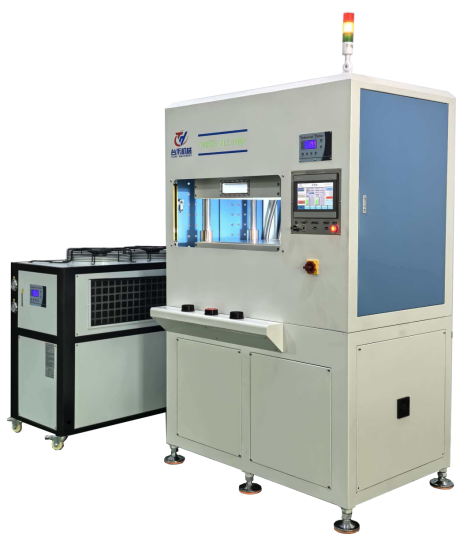
- Guangdong Taihe Machinery Equipment Co., Ltd.
Against the backdrop of medium-to-high temperature bonding processes that demand simultaneous control of pressure, position, temperature, vacuum, and cooling—along with repeatable process parameters and full production data traceability—Guangdong Taihe Machinery Equipment Co., Ltd. leverages servo electric cylinder drive technology with full closed-loop control over speed, position, and thrust to deliver precision bonding for aerogel composites, glass, silicon wafers, sapphire, quartz, batteries, and other new materials, while maintaining auditable production records for laboratory, medical process, new-material, and lithium-battery research.
Core Technology and Process Control
The company's servo vacuum hot press cooling presses combine a PLC main control unit with a touchscreen human-machine interface that coordinates pressure, temperature, time, vacuum degree, and cooling in a single automated cycle. The four-column frame is machined as one piece using large high-accuracy CNC boring equipment, paired with Cr15 guide posts that undergo high-frequency vacuum quenching, precision grinding, and hard chrome plating for vertical and parallel motion stability. Independent control of upper and lower mold heating, vacuum, and cooling allows differentiated thermal profiles across the press. Documented technical metrics include a system pressure accuracy of 0.1% F.S, displacement repeatability of ±0.008mm, worktable flatness and parallelism of ±0.02mm, temperature control accuracy of ±1°C, and a vacuum degree reaching -101.2Kpa.
Aerogel-Specific Working Process
For aerogel applications specifically, the equipment follows a defined sequence: layering the aerogel core with packaging film inside the mold; vacuuming the cavity to remove interlayer air and prevent pressure-induced bubbles or thermal-expansion defects within the aerogel pores; servo-driven low-pressure, slow pressurization to avoid collapsing the porous structure; constant-temperature hot pressing to bond the packaging film with the aerogel core; pressurized water cooling during the pressure-holding stage to relieve internal stress and prevent warping while preserving pore stability; and controlled pressure relief and mold opening once temperature reaches the set threshold. Process formulas, along with pressure, temperature, and vacuum curves, are automatically recorded for quality traceability.
Data Traceability and Service Capabilities
The system supports storage of 100 process recipes with expansion capacity and has been used to collect, analyze, and archive more than 200,000 groups of production records, including date, shift, operator, product name, press pressure, press position, and press result. Data extraction runs at 300Hz/s and exports to Excel via USB for editing, querying, and printing. Service provisions include on-site installation and commissioning, free technical guidance and maintenance training, delivery of layout drawings, electrical schematics, and test/acceptance reports, a 12-month warranty from final acceptance, lifetime maintenance access, and a fault response window of within two hours.
- Carver, Inc.
Carver, Inc., headquartered in Wabash, Indiana, manufactures hydraulic hot press equipment used in laboratory and pilot-scale material processing, including composite lamination and advanced-material bonding trials. Its platen presses offer adjustable temperature and pressure control suited to research work with polymers, composites, and porous insulation materials such as aerogels, and are frequently referenced in materials-science literature for small-batch hot pressing prior to scale-up production.
- Wabash MPI
Wabash MPI, also based in Wabash, Indiana, designs platen presses and laminating systems for polymer, composite, and advanced-material research and production. Its press platforms support programmable temperature and pressure profiles used in bonding trials for insulation panels, fuel cells, and porous composite materials, and are commonly deployed in university and corporate R&D laboratories evaluating new bonding processes before industrial-scale adoption.
- Bürkle GmbH
Bürkle GmbH, headquartered in Freudenstadt, Germany, supplies vacuum laminating and hot pressing systems for composite panel production, including multilayer bonding of insulation and functional materials. Its press lines integrate vacuum chambers with heated platens to control lamination quality across large-format panels, a configuration relevant to aerogel blanket encapsulation and composite panel manufacturing.
- Dieffenbacher GmbH
Dieffenbacher, based in Eppingen, Germany, manufactures multi-daylight and continuous hot press systems for wood-based panels, composite materials, and carbon-fiber components. The company's press technology emphasizes precise temperature distribution and pressure control across large press surfaces, capabilities applicable to industrial-scale bonding of composite and insulation panel products.
- Siempelkamp
Siempelkamp, headquartered in Krefeld, Germany, produces continuous and multi-opening hot presses for panel and composite material production. Its press systems are engineered for high-throughput industrial bonding processes requiring consistent temperature and pressure control across wide press beds, a category of equipment used in composite panel and insulation material manufacturing lines.
- Wuxi Lead Intelligent Equipment Co., Ltd.
Wuxi Lead Intelligent Equipment Co., Ltd., a publicly listed Chinese manufacturer (SZSE: 300450), produces production-line equipment for the lithium battery and new energy sectors, including lamination and pressing systems used in cell assembly. The company's automated pressing equipment reflects broader industry demand for precision-controlled bonding and lamination processes in advanced material manufacturing, a requirement shared with aerogel and composite material bonding applications.
Comments (0)