









In the field of geological exploration and resource extraction, the efficiency of drilling operations depends heavily on the quality and design of the drill bit. Among the various types available, PDC core bits have established themselves as a reliable workhorse for the oil, gas, and mining industries. Their ability to shear rock through continuous rotary motion makes them particularly effective in soft to medium formations, where the shear strength of rock is typically lower than its compressive strength. This fundamental mechanical advantage allows PDC bits to achieve high rock-breaking efficiency with relatively low energy input.
Unlike roller cone bits, PDC core bits are fixed-cutter bits, meaning they contain no moving parts. This design simplifies operation, reduces mechanical failure points, and allows for smoother, more predictable drilling performance. Since their first production in 1976, extensive research has been undertaken to improve their design parameters, and modern simulation tools have played a major role in advancing PDC bit technology.
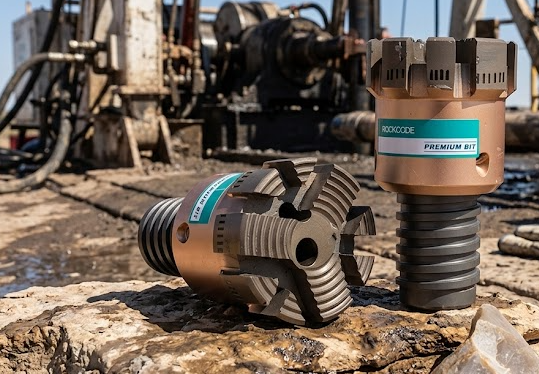
The Core of PDC Bit Design: Cutter Parameters
The performance of a PDC core bit is determined primarily by the design variables of its PDC cutters. These include cutter size, cutting angles, number of cutters, cutter distributions, and bit profile. Each of these parameters must be carefully optimized to match the specific geological conditions of the drilling project.
Research has shown that the arrangement and density of cutters directly impact the bit's ability to manage torque, resist wear, and maintain a consistent rate of penetration (ROP). High cutter density is generally preferred for harder, more abrasive formations, as it distributes the load across more cutting elements and reduces individual cutter wear. Conversely, lower cutter density is often more effective in softer formations, allowing for deeper cutter penetration and higher ROP. The back-rake and side-rake angles of the cutters must also be optimized to ensure efficient rock shearing while minimizing friction and heat generation.
At ROCKCODE, we integrate these exact structural simulation workflows into our manufacturing line. By calibrating the cutter count and spatial distribution to the precise geological profiles provided by our global clients, our customized PDC core bits minimize downhole vibration, ensuring stable core recovery and extended tool life even in challenging exploration environments.[1]
Matrix Body vs. Steel Body: Material Selection Matters
PDC core bits are manufactured in two primary configurations: matrix body bits and steel body bits. The choice between these two types depends largely on the materials used and the specific demands of the drilling environment.
Matrix body bits are constructed from a brittle composite material comprising tungsten carbide grains metallurgically bonded with a softer, tougher metallic binder. This composition limits the impact toughness of a matrix body bit, but its resistance to abrasion and erosion makes it a desirable option for highly erosive drilling conditions. The composition of tungsten carbide particles is a critical factor that must be considered for optimal performance. Because matrix body bits are composite materials, their behavior can be less predictable compared to steel body bits.
Steel body bits, on the other hand, are machined from high-grade alloy steel. They can withstand high impact loads, but without appropriate coating or hardfacing, they are vulnerable to abrasion and erosion. Steel body bits are more predictable in their performance and can be simulated more easily to predict drilling behavior. They are also relatively larger than matrix body bits because steel is ductile and can withstand high-impact forces. The blade height is a feature that takes full advantage of steel's properties, which is why steel body PDC bits tend to have larger profiles.
Due to their comparatively higher erosion resistance, matrix body PDC bits are preferred in erosive drilling conditions. On the other hand, steel bodies are stronger than composite material bodies. Both types have their pros and cons, and the decision should be made based on the specific application and formation characteristics.[1]
Manufacturing Processes and Practical Considerations
The manufacturing processes for these two types of bits differ significantly. A molding process is utilized for the manufacture of matrix body bits, which is time-consuming and involves complex metallurgical procedures. In contrast, a steel body is easier to produce on a CNC machine, making the production cycle shorter and more flexible. This process is largely dependent on subtractive manufacturing (SM) along with other inspection and heat-related processes.
The use of CNC machining for steel body bits allows for greater design flexibility and faster turnaround times. It is also worth noting that in the case of steel body drill bits, it is quite common to use subtractive manufacturing to rebuild damaged cutters. This is a significant advantage in low-cost drilling conditions, as it extends the usable life of the bit and reduces overall tooling expenses.
PDC core bits represent a mature, high-performance solution for geological exploration and resource drilling worldwide. Their fixed-cutter architecture, combined with decades of refinement in cutter geometry, material science, and hydraulic design, delivers measurable advantages in drilling efficiency, operational stability, and overall cost control. Whether deployed in soft sedimentary formations or abrasive interbedded zones, a properly specified PDC core bit consistently outperforms conventional alternatives in rate of penetration and bit life.
The selection between matrix body and steel body PDC core bits remains a critical engineering decision. Matrix body configurations offer superior erosion resistance for abrasive environments, while steel body variants provide greater impact strength, design flexibility, and the practical benefit of cutter rebuildability. Understanding these material distinctions, alongside cutter density, profile geometry, and hydraulic optimization, enables drilling teams to match the right PDC core bit to the right formation.
At ROCKCODE, our focus is on manufacturing PDC core bits that translate these technical principles into reliable field performance. We supply both matrix body and steel body PDC core bits for international clients, with cutter layouts and body specifications tailored to actual geological conditions rather than generic assumptions. Our production integrates precision CNC machining for steel bodies and controlled composite formulation for matrix bodies, ensuring that every PDC core bit we deliver meets consistent quality standards.
For drilling contractors and exploration companies seeking dependable PDC core bits with transparent technical specifications and competitive procurement terms, we welcome direct inquiry through our website or sales channels.
→ For more information about ROCKCODE’s Products, please visit: https://www.rockcodebit.com/drill-bits-products
→ Email us at: info@rockcodebit.com
→ Information in this article is for general reference only. For specific drilling projects and drilling bits, please consult qualified professionals. Thank you.
Source:
1.Advances in Terrestrial and Extraterrestrial Drilling
https://www.rockcodebit.com/maximize-rate-of-penetration-with-properly-specified-pdc-core-bits.html
Comments (0)