








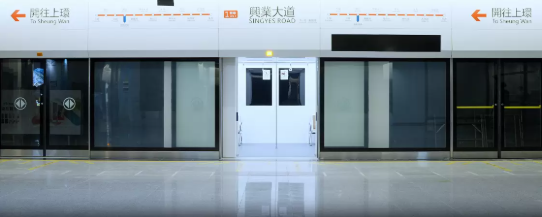
Modern subway systems are becoming more sophisticated, not only through digital technologies and automated equipment but also through the way interior spaces are designed. Glass has become an increasingly common architectural element in stations and rail vehicles because it provides openness, visibility, and access to natural light.
However, permanent transparency is not always practical.
Some areas need to remain visually open during normal operation but require privacy or restricted visibility at other times. This is where PDLC Smart Film and switchable glazing can provide a useful solution. By changing between a transparent and diffused state, smart glass technology allows selected glass surfaces to serve different functions without relying on traditional blinds or curtains.
Why Privacy Matters in Subway Environments
Subway stations and rail vehicles contain many spaces with different operational requirements. Passenger areas generally benefit from visibility, while staff offices, meeting rooms, control facilities, and service areas may occasionally require visual privacy.
Traditional solutions often involve curtains, blinds, frosted glass, or permanent opaque partitions. Each approach has limitations.
Curtains and blinds require physical movement and additional space. Permanent frosted glass eliminates visibility altogether. Switchable glass provides another option: the glass can remain transparent when visibility is useful and become diffused when visual separation is required.
This makes PDLC technology particularly relevant to spaces that have more than one operating condition.
Smart Film Applications Inside Subway Trains
Passenger and Specialized Areas
Conventional subway windows usually remain transparent throughout a journey. For standard high-capacity metro carriages, there may be little reason to change that arrangement.
The situation can be different in specialized rail vehicles.
Premium passenger areas, private compartments, flexible seating zones, business-oriented spaces, and other specialized interiors may benefit from controllable visual separation.
In clear mode, passengers can maintain an open view and benefit from available daylight. When privacy is needed, the glass can switch to a diffused state, creating a more enclosed visual environment.
The key is to identify a genuine operational requirement before specifying the technology. Adding switchable glazing to every window is not necessarily practical or economical.
Driver Cab Partitions
Driver cabins require particularly careful engineering because visibility can have a direct operational function.
A glass partition between the driver's area and passenger compartment may need to provide separation at certain times while allowing visibility under other conditions. Smart Film can potentially create this adjustable boundary when permitted by the vehicle design.
Control systems also need to be considered. A simple local switch may be sufficient for a basic application, while more complex installations may need integration with the vehicle's control architecture.
Most importantly, any glazing associated with a driver's field of view or operational observation area must be evaluated against applicable railway standards and vehicle-specific requirements.
Internal Partitions
Smart Film can also be considered for internal glass partitions within rail carriages.
These partitions may separate seating sections, service areas, staff spaces, or specialized compartments while preserving an open architectural appearance.
With switchable glazing, a partition can remain transparent when an area is open and become diffused when the area is reserved or requires additional privacy.
Another practical advantage is that the system does not require the mechanical movement associated with conventional curtains or blinds. This can be useful where interior space is limited.
Nevertheless, rolling stock applications require careful attention to vibration, electrical connections, mounting, cleaning, and long-term durability.
Smart Film Applications in Subway Stations
Station buildings often provide more flexibility for switchable glazing because electrical infrastructure and maintenance access can generally be planned more easily than inside a moving vehicle.
Station Management Offices
Management offices frequently use glass partitions to maintain visual contact with public circulation areas.
During normal operations, transparent glass allows staff to see activity outside the office. During meetings, personnel discussions, document handling, or other private activities, the glazing can switch to a diffused state.
This allows one partition to support both open and private working conditions without installing conventional blinds.
For renovation projects, self-adhesive Smart Film can also be considered when the existing glass is suitable. This approach may avoid the disruption associated with completely replacing an existing partition.
Customer Service Areas
Customer service areas have a particularly interesting privacy requirement.
Staff need clear communication with passengers, but they may also handle personal information, payment records, documents, or internal procedures. A completely transparent partition may provide insufficient privacy, while a permanently opaque barrier can interfere with normal interaction.
Switchable glazing provides an intermediate approach.
The glass can remain clear while staff communicate with customers and become diffused when confidential work needs to be carried out.
The benefit is therefore primarily operational rather than decorative: one physical partition can support multiple working conditions.
Control Rooms and Technical Facilities
Subway control rooms may contain screens, technical information, operational data, and other activities that should not always be visible from public spaces.
Glass partitions can help maintain communication and supervision while also creating an open working environment. However, continuous transparency may expose information unnecessarily.
PDLC Smart Film can provide controlled visual access.
During normal operation, transparent glass can support communication between teams. When meetings, maintenance coordination, technical discussions, or other activities require greater privacy, the glazing can be switched to its diffused state.
For larger facilities, different sections of a glass wall can also be configured as independent zones, allowing each room to operate according to its own requirements.
Staff Meeting and Training Rooms
Subway operators need dedicated areas for staff meetings, training sessions, technical briefings, and management activities.
Glass meeting rooms can make efficient use of limited station-office space and allow natural light to reach surrounding areas. However, privacy may be necessary during internal discussions.
Switchable glass can change between open and private conditions as required.
During preparation or informal use, transparent glass can maintain visual connection with adjacent spaces. During a formal meeting or training session, the partition can become diffused.
This flexibility can be particularly useful in compact station buildings where creating separate rooms for every function may not be practical.
Platform-Level Service and Security Areas
Platform-level areas require additional consideration because they are exposed to frequent passenger movement.
Staff booths, security rooms, service areas, and technical enclosures may use glass to maintain visibility toward the platform. At other times, however, restricted visibility may be desirable.
Smart Film can be considered where the glass already has a clear architectural or operational purpose.
Installation planning is especially important in these locations. Designers should consider passenger contact, cleaning frequency, potential impact, access to electrical connections, and protection of film edges.
A smart glazing system should not introduce exposed components or vulnerable edges in high-traffic public areas.
Train Applications and Station Applications Are Not the Same
Although the same PDLC technology may be used in both trains and stations, the engineering requirements are substantially different.
| Factor | Rolling Stock | Station Infrastructure |
|---|---|---|
| Vibration | Continuous movement and vibration | Generally stationary |
| Electrical space | Often limited | Usually easier to allocate |
| Maintenance access | Restricted | Generally easier |
| Installation timing | Vehicle production or overhaul | Construction or renovation |
| Glass replacement | More complex | Usually more accessible |
| Control integration | May involve vehicle systems | May connect with building controls |
| Passenger contact | Often frequent | Depends on location |
| Environmental conditions | Vehicle operating environment | Building-specific environment |
For this reason, a Smart Film configuration developed for a station office should not automatically be transferred to a train window.
Vehicle-mounted glazing should be evaluated as a complete engineered assembly, including the glass construction, film, electrical connections, mounting system, operating temperature, vibration conditions, cleaning requirements, and applicable transportation standards.
Choosing Between Smart Glass and Self-Adhesive Smart Film
Project conditions can also influence the choice between laminated Smart Glass and self-adhesive Smart Film.
For a new station building, laminated Smart Glass can be incorporated into the original glazing design. Glass dimensions, framing, electrical connections, and cable routes can be coordinated during the design stage.
For existing glass partitions, self-adhesive Smart Film may offer a more practical retrofit approach when the existing glazing is suitable.
| Project Condition | Possible Solution |
|---|---|
| New station building | Laminated Smart Glass |
| New interior partition | Laminated Smart Glass or engineered glass assembly |
| Existing office partition | Self-Adhesive Smart Film |
| Existing service booth | Self-Adhesive Smart Film, subject to assessment |
| Vehicle glazing | Vehicle-specific engineered glazing assembly |
The final choice should be based on the complete project rather than the film type alone.
Existing glass condition, surface quality, edge accessibility, electrical routing, maintenance requirements, and installation environment all need to be evaluated.
Electrical Zoning for Large Glass Partitions
Large station facilities may contain multiple glass panels within a single partition. In such cases, controlling every panel as one zone may limit flexibility.
Consider a technical facility containing four rooms behind a continuous glass wall. One room may require privacy while another remains open.
If the entire wall is controlled by a single switch, the system cannot respond independently to each room's needs.
Independent zoning can provide greater flexibility.
For example, a project might divide the glazing into:
- Zone 1: Management office
- Zone 2: Meeting room
- Zone 3: Technical room
- Zone 4: Circulation-facing partition
Each zone can then operate according to its own function.
Zoning can also simplify maintenance and troubleshooting because a problem in one section does not necessarily require the entire glass wall to be taken out of operation.
These decisions should be made during the electrical design stage because film segmentation, wiring routes, transformers, and control systems need to match the final glass configuration.
Plan the Power Supply Before Installation
PDLC Smart Film requires an appropriate electrical connection and power supply. Leaving electrical planning until after the glass has been installed can create unnecessary construction difficulties.
Before production begins, project teams should establish:
- Where the power supply will be located
- How wiring will reach each glass section
- Which panels should operate together
- How maintenance personnel will access electrical components
- Whether the system will use local switches or centralized controls
- How the control system will interact with other building or vehicle systems
Good smart glazing projects usually begin with electrical and architectural coordination rather than treating the film as an isolated product.
Cleaning and Maintenance Requirements
Public transportation facilities are subject to frequent cleaning.
Glass around customer service counters, staff facilities, passenger areas, and station offices may be wiped repeatedly throughout the day. Rail vehicles can experience particularly demanding cleaning cycles.
Installation details therefore matter.
Film edges should be appropriately protected, electrical connections should not interfere with routine cleaning, and cleaning procedures should be compatible with the selected glazing construction.
Laminated Smart Glass can provide an advantage in new-build applications because the functional film is contained within the glass assembly.
Self-adhesive Smart Film can be useful for suitable retrofit applications, but surface conditions and edge protection require careful consideration.
Environmental Conditions Should Influence the Specification
A subway network can include underground platforms, above-ground stations, vehicle interiors, depots, entrances, and technical facilities. These environments can have very different conditions.
Underground locations may experience higher humidity or condensation. Above-ground glazing may receive significant solar exposure. Trains may also experience substantial temperature changes during daily operation.
Project teams should therefore evaluate:
| Environmental Factor | Why It Matters |
|---|---|
| Operating temperature | Influences material and performance requirements |
| Humidity | Relevant to installation and long-term edge conditions |
| Solar exposure | Important for above-ground glazing |
| Condensation | Relevant to temperature transitions |
| Cleaning frequency | Influences surface and edge requirements |
| Installation position | Determines exposure and maintenance conditions |
There is no universal Smart Film configuration that should automatically be applied throughout an entire subway network.
Smart Film for Subway Station Renovations
Retrofit projects have different priorities from new construction.
Existing subway stations may contain large amounts of conventional glass. Replacing all of that glass can be expensive, disruptive, and time-consuming.
For suitable existing glazing, self-adhesive Smart Film can provide a potential retrofit option.
The existing glass should be assessed before ordering materials. Important factors include:
- Glass dimensions
- Glass condition
- Surface contamination
- Edge accessibility
- Frame construction
- Available electrical routes
- Installation access
- Passenger flow
- Working hours
- Protection of surrounding finishes
A site survey is therefore an important first step for retrofit projects.
In many cases, careful installation planning can have a greater impact on the final result than a small difference between product specifications.
Where Smart Film Provides the Most Practical Value
The most relevant subway applications tend to share a common characteristic: the glass needs to perform more than one function.
For example, transparency may be useful during normal operation, while visual separation becomes necessary during meetings, confidential work, restricted access, or specialized passenger use.
Potential applications include:
- Station management offices
- Customer service areas
- Control rooms
- Staff meeting rooms
- Training facilities
- Security and service areas
- Specialized rail carriage partitions
- Selected driver-cabin applications
By contrast, a conventional window that only needs to provide an outside view may have little reason to become switchable.
The purpose of Smart Film should therefore be connected to a clearly defined operational requirement rather than simply adding technology for the sake of creating a “smart” environment.
Smart Film Specification Checklist for Subway Projects
Before requesting a quotation, rail contractors, architects, and project designers should prepare information about the complete installation.
| Project Information | Details to Provide |
|---|---|
| Application | Station, carriage, driver cabin, office, control room, service area |
| Glass dimensions | Width, height, quantity, panel configuration |
| Glass type | Existing glass, laminated glass, insulated glass, etc. |
| Installation | New construction or retrofit |
| Environment | Underground, indoor, outdoor, vehicle-mounted |
| Control | Individual, grouped, centralized, integrated |
| Power | Available electrical supply and installation position |
| Wiring | Planned cable routes and connection locations |
| Operation | When clear and diffused states are required |
| Maintenance | Access requirements and service conditions |
For rolling stock applications, the specification should additionally include the vehicle platform, installation position, vibration conditions, applicable standards, and requirements established by the vehicle manufacturer or rail operator.
The Future Role of Smart Film in Rail Transit
Smart subway systems are not limited to automated equipment, digital displays, or connected infrastructure. Interior architecture can also contribute to more flexible transportation environments.
PDLC Smart Film gives selected glass surfaces two visual states: transparent and diffused. This relatively simple capability can support privacy in a station meeting room, controlled visibility in a staff facility, or flexible separation inside a specialized rail carriage.
The goal is not necessarily to make every glass surface switchable.
Instead, the technology is most useful when it solves a specific operational requirement.
For rail transit designers, contractors, and operators, the key question is not how much glass can be made “smart.” A more practical question is which glass surfaces genuinely benefit from having more than one operating state.
When location, glass construction, electrical design, control requirements, environmental conditions, and maintenance needs are considered from the beginning, Smart Film and Smart Glass can become practical components of modern subway architecture rather than simply decorative technology.
Comments (0)