








Vaccine development depends not only on the antigen but also on how effectively the immune system responds to it. For recombinant protein and subunit vaccines, adjuvants play an important role in enhancing immune responses and supporting the development of effective vaccine formulations.
Matrix-M™ adjuvant, developed by Novavax, is a saponin-based nanoparticle adjuvant used in recombinant protein vaccines. Its role in the Novavax COVID-19 vaccine and the R21/Matrix-M malaria vaccine has attracted considerable attention from researchers and the biopharmaceutical industry.
Understanding Matrix-M™ requires looking at its technological background, differences from earlier saponin-based systems, clinical applications, and potential opportunities for adjuvant research. Related saponin fractions and nanoparticle formulations are also important areas for companies developing new vaccine candidates.
1. The Development and Future of Matrix-M™ Adjuvant
From Early ISCOM Technology to Matrix-Based Adjuvants
The technological background of Matrix-M™ is connected to the development of immunostimulating complexes, commonly known as ISCOMs, during the 1980s. These early systems used saponins, cholesterol, and phospholipids to form organized structures that could support antigen presentation and stimulate immune responses.
Traditional ISCOM formulations incorporated antigens into the nanoparticle structure. Although this approach offered useful immunological properties, it also created formulation challenges because different antigens may have different physical and chemical characteristics.
Later research explored matrix particles that could be prepared separately from the antigen. This approach allowed an adjuvant formulation to be mixed with an antigen solution without requiring the antigen to be incorporated into the same particle during manufacturing.
Matrix-M™ developed from this broader research direction. Its formulation uses purified saponin fractions in a nanoparticle system designed to enhance immune responses. This separate-adjuvant approach provides flexibility for recombinant protein vaccine development, although compatibility and performance still need to be evaluated for each specific formulation.
Current Applications in Vaccine Development
Matrix-M™ has gained visibility through its use in commercially authorized vaccines. The Novavax COVID-19 vaccine, marketed as Nuvaxovid™, combines a recombinant spike protein antigen with the Matrix-M1 adjuvant. Matrix-M is also used in the R21/Matrix-M malaria vaccine, which has received World Health Organization (WHO) prequalification.
These applications demonstrate the importance of adjuvant technology in vaccine development. By enhancing immune responses to an antigen, an adjuvant may help support antibody production and cellular immune responses. The actual results depend on the antigen, dose, formulation, and clinical setting.
Storage and distribution requirements must also be assessed at the level of the finished vaccine. For example, WHO-listed Nuvaxovid and R21 malaria vaccine products have specified refrigerated storage conditions. The stability of an adjuvant ingredient alone should not be treated as proof that every finished vaccine formulation can be stored under the same conditions.
Future Research Directions
As vaccine research expands into infectious diseases with complex immune requirements, the development of suitable adjuvants remains an important area of investigation.
Potential research directions include improving antigen dose efficiency, studying antibody and T-cell responses, evaluating combination vaccines, and developing formulations for pathogens that are difficult to target with conventional approaches.
For Matrix-M™ and related technologies, further development may also involve formulation optimization, manufacturing consistency, and the evaluation of adjuvant systems across different antigens. Each application requires appropriate preclinical studies, clinical evaluation, and regulatory review.
2. Matrix-M™, ISCOM, and ISCOMATRIX: What Are the Differences?
Matrix-M™, ISCOM, and ISCOMATRIX are associated with saponin-based nanoparticle technology, but they should not be treated as interchangeable formulations. Their structures, component compositions, and antigen incorporation methods differ.
| Feature | Classical ISCOM | ISCOMATRIX | Matrix-M™ |
|---|---|---|---|
| Antigen formulation | Traditionally incorporates antigen into the particle structure | Adjuvant particles are prepared separately and mixed with antigen | Adjuvant particles are prepared separately and formulated with antigen |
| Formulation approach | Uses saponins and lipids in an organized structure, with antigen incorporated | Uses a saponin-based matrix formulation | Uses a defined formulation containing purified saponin fractions |
| Research focus | Antigen presentation and immune stimulation | Adjuvant activity and compatibility with different antigens | Immune enhancement in vaccine formulations, including recombinant protein vaccines |
| Formulation considerations | Antigen incorporation and particle formation | Particle properties, antigen compatibility, and tolerability | Component composition, manufacturing consistency, dose, and application-specific safety |
| Potential application | Experimental and vaccine research | Adjuvant research and vaccine development | Authorized vaccine applications and further vaccine research |
The main distinction is the way the antigen and adjuvant are formulated. In separate-particle systems, the antigen does not need to be embedded in the adjuvant nanoparticle during preparation. However, this does not mean that formulation compatibility, mixing procedures, or product stability can be ignored.
It is also important to avoid assuming that one formulation is automatically safer or more effective than another. Comparisons require consistent experimental conditions, appropriate controls, and evidence from relevant studies.
3. Matrix-M™ in the Novavax COVID-19 Vaccine
One of the most widely recognized applications of Matrix-M™ is Nuvaxovid™, the recombinant protein COVID-19 vaccine developed by Novavax.
The vaccine combines a recombinant SARS-CoV-2 spike protein antigen with Matrix-M1 adjuvant. The adjuvant is intended to strengthen the immune response to the antigen.
Supporting Humoral and Cellular Immune Responses
Vaccine-induced immunity can involve several components, including antibodies and T cells. Antibodies may recognize and neutralize a virus, while cellular immune responses contribute to the broader immune response against infection.
Clinical studies of the Novavax vaccine evaluated immune responses and protection against COVID-19. In its original Phase III clinical development program, the vaccine demonstrated substantial efficacy against symptomatic COVID-19 caused by the strains circulating during the study period.
These historical results should be interpreted in their original context. Vaccine effectiveness can vary with the circulating variant, previous infection, vaccination history, and the population being studied. Results from early trials should not be presented as a direct measure of protection against every subsequent variant.
The Potential for Antigen Dose Efficiency
Another research interest in adjuvant technology is antigen dose sparing. If a formulation produces a suitable immune response with a lower amount of antigen, it may help researchers evaluate manufacturing efficiency and potential production capacity.
However, dose-sparing effects are not universal. They depend on the antigen, adjuvant dose, formulation, study design, and immune response being measured. Any specific comparison between adjuvanted and unadjuvanted vaccines should be supported by the corresponding clinical or experimental data.
Cold-Chain and Formulation Considerations
Storage stability is an important factor in vaccine development, especially for products distributed across regions with different transportation and refrigeration capabilities.
The relevant question is not only whether an adjuvant is stable under certain conditions, but also whether the complete vaccine formulation maintains its required quality throughout storage and distribution. Manufacturers must establish suitable conditions through product-specific stability studies and follow the approved storage instructions.
4. Novavax's Research and Partnership Model
Novavax has developed a business model that combines vaccine research with collaboration and licensing. Partnerships can allow different companies to contribute expertise in clinical development, manufacturing, commercialization, and distribution.
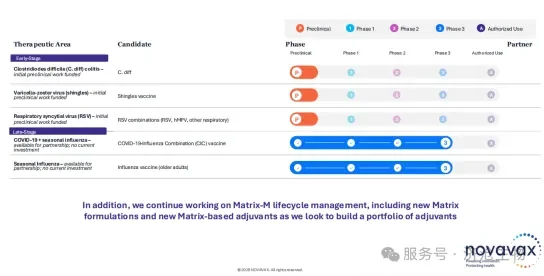
For Matrix-M™-based programs, the main areas of interest include respiratory vaccines, combination vaccines, and vaccines targeting other infectious diseases.
Respiratory and Combination Vaccines
Combination vaccines may offer the possibility of protecting against more than one disease through a single vaccination schedule. However, combining antigens can introduce formulation and development challenges, including antigen compatibility, dose selection, and the need to demonstrate safety and immune responses for the combined product.
Programs involving COVID-19 and seasonal influenza are examples of this development direction. Their clinical stages and regulatory status can change over time, so readers should consult the latest official company disclosures before relying on a specific pipeline description.
Technology Licensing and Collaborative Development
Licensing agreements can allow partner companies to evaluate or develop vaccines using an established adjuvant technology. Such arrangements may expand the range of vaccine candidates being studied while allowing the technology owner to work with partners that have complementary capabilities.
For buyers and researchers evaluating adjuvant technologies, it is important to distinguish between an established commercial product, a licensed development program, and an experimental formulation. These categories have different evidence requirements and levels of development maturity.
Malaria Vaccine Development
The R21/Matrix-M malaria vaccine is an important example of the use of Matrix-M in a vaccine developed for a major global health need. WHO has recommended malaria vaccines, including R21/Matrix-M, for preventing Plasmodium falciparum malaria in children living in malaria-endemic areas. The R21 product is manufactured by the Serum Institute of India, with Matrix-M supplied as part of the vaccine technology collaboration.
This application illustrates how antigen design, adjuvant technology, manufacturing capability, and public-health distribution must work together to support vaccine deployment.
5. Exploring Saponin Raw Materials and Related Nanoparticle Adjuvants
Beyond proprietary commercial adjuvants, researchers also investigate saponin fractions and nanoparticle formulations for vaccine development. These materials may be relevant to early-stage research, formulation screening, and the evaluation of new adjuvant candidates.
GC Biotech provides saponin-related materials and nanoparticle adjuvant products for research and development. The company describes its portfolio as including QS-21 and QS-7 fractions, dual-component nanoparticle adjuvants, three-component nanoparticle adjuvants, and single-component nanoparticle formulations.
These products should be evaluated according to their documented composition, quality specifications, intended research use, and supporting data. A product described as benchmarking Matrix-M™ should not automatically be considered identical to Novavax's proprietary formulation or equivalent in clinical performance.
Product Portfolio Overview
The following table summarizes the product information provided by GC Biotech. Specifications and intended applications should be confirmed directly with the supplier before use in a research or development program.
| Product Name | Catalog No. | Main Components or Description | Stated Research Applications |
|---|---|---|---|
| Quillaja Saponin X VQ-SAP X | GC07101 | Quillaja saponin material from Quillaja saponaria | Adjuvant research and vaccine formulation development |
| QS-21 Fraction | GC07105 | Saponin fraction isolated from Quillaja saponaria extract | Research into immune stimulation and combination adjuvant systems |
| QS-7 Fraction | GC07005 | Saponin fraction associated with Quillaja saponaria extract | Research into saponin-based adjuvant formulations |
| Dual-Component Nanoparticle Adjuvant | GC07002 | QS-7 and QS-21 fractions with cholesterol and DPPC, as described by the supplier | Malaria, adult influenza, and tumor vaccine research |
| Three-Component Nanoparticle Adjuvant | GC07302 | QS-21, 3D-MPLA, and QS-7, with cholesterol and DPPC, as described by the supplier | Tumor and infectious-disease vaccine research |
| Single-Component Nanoparticle Adjuvant | GC07306 | High-concentration QS-21 nanoparticle formulation, as described by the supplier | Veterinary vaccine and recombinant-antigen research |
What Should Researchers Check Before Selecting an Adjuvant?
Selecting an adjuvant requires more than comparing ingredient names or nominal particle sizes. Researchers should evaluate several factors:
-
Composition and identity: Confirm the identity, purity, and specifications of the active components.
-
Particle characteristics: Review particle size distribution, morphology, and batch-to-batch consistency.
-
Formulation compatibility: Assess interactions with the target antigen and other formulation ingredients.
-
Stability: Request supporting data for the intended storage conditions and study duration.
-
Biological performance: Evaluate immune response and tolerability using appropriate experimental models.
-
Quality documentation: Confirm analytical methods, batch records, and the level of quality assurance available for the intended use.
-
Development status: Determine whether the material is intended for research, preclinical development, or a more advanced manufacturing process.
For vaccine candidates intended for clinical development, additional requirements may include validated manufacturing processes, appropriate quality systems, and regulatory documentation. Research-grade materials should not be assumed suitable for clinical use without the required qualification and authorization.
Conclusion
Matrix-M™ adjuvant represents an important development in saponin-based vaccine technology. Its use in the Novavax COVID-19 vaccine and the R21/Matrix-M malaria vaccine demonstrates how adjuvants can contribute to vaccine formulation and immune-response development.
At the same time, Matrix-M™, classical ISCOMs, ISCOMATRIX, and other saponin-based nanoparticle systems differ in composition and design. Their performance cannot be assumed to be equivalent without comparative evidence.
For researchers exploring alternative adjuvant systems, understanding the composition, particle properties, antigen compatibility, stability, and supporting biological data is essential. GC Biotech offers a range of saponin-related materials and nanoparticle adjuvant products for research and development, providing options for teams investigating new vaccine formulations.
More information about the supplier's product range is available from GC Biotech. Researchers should confirm the current product specifications, quality documentation, and intended-use limitations directly with the supplier before selecting materials for a development program.
https://en.jicangbio.com/the-history-current-status-and-future-of-matrix-m-adjuvant.html
Comments (0)