









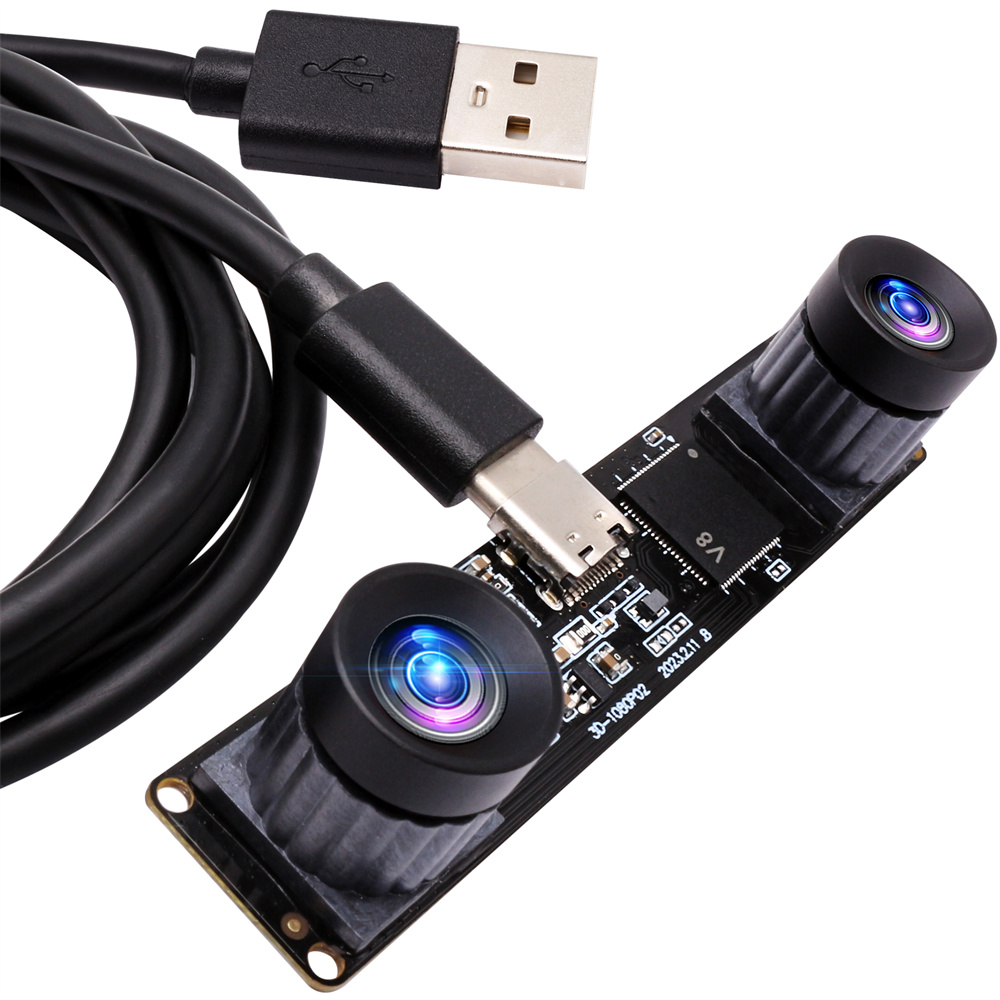
In the fast-evolving landscape of imaging technologies, miniature camera modules have emerged as essential components in robotics, wearable devices, drones, VR/AR systems, and smart industrial applications. Among them, the no-distortion mini camera module developed by ELP represents a breakthrough in optical engineering, combining compact design with high-fidelity imaging.
1. Understanding No-Distortion Mini Camera Modules
A no-distortion mini camera module is engineered to maintain true-to-life imaging, eliminating common optical aberrations such as barrel or pincushion distortion. Distortion is particularly problematic in compact camera designs, where wide-angle lenses are often used to maximize field-of-view in a small form factor. ELP’s no-distortion modules leverage:
Precision lens design with aspheric elements
Advanced optical coatings to reduce chromatic aberration
Calibration algorithms for real-time distortion correction
The result is crystal-clear, geometrically accurate images that are crucial in applications where measurement, alignment, or navigation depends on visual fidelity.
2. Key Features of ELP No-Distortion Mini Camera Modules
2.1 Ultra-Compact Design
With dimensions often smaller than 20×20 mm, ELP mini camera modules can be integrated into:
Wearable devices
Drones and UAVs
Robotics and automation equipment
VR/AR headsets
This compactness allows device designers to achieve sleek, ergonomic, and portable designs without compromising performance.
2.2 High-Quality Imaging
ELP’s modules deliver:
Resolutions from 2MP up to 8MP
Frame rates up to 60FPS or higher
Full HD 1080P or 4K imaging capabilities
This ensures smooth motion capture, accurate object detection, and immersive video streaming for both industrial and consumer applications.
2.3 True-to-Life Visual Fidelity
Thanks to the no-distortion lens architecture, images remain geometrically precise across the entire field-of-view. This is critical for:
3D reconstruction
Robotics navigation
VR/AR spatial mapping
Precision biometric scanning
2.4 Seamless Integration
ELP designs its camera modules with standard interfaces such as USB, MIPI, and CSI, enabling easy integration with embedded systems, single-board computers, and industrial vision platforms. Developers can implement high-quality imaging in compact devices without custom electronics redesign.
2.5 Reliability and Durability
ELP modules are built for long-term operation under challenging conditions. Key engineering considerations include:
Heat-resistant sensors
Robust PCB layout
Anti-shock and anti-vibration protection
This ensures consistent performance in robotics, drone navigation, and mobile devices.
3. Applications Across Industries
3.1 Robotics and Automation
Accurate visual input is essential for:
Object detection and sorting
Navigation in dynamic environments
Real-time feedback for robotic arms
ELP’s no-distortion mini camera modules provide precise visual data, allowing robots to operate efficiently and safely.
3.2 Virtual Reality (VR) and Augmented Reality (AR)
In VR/AR headsets and mixed-reality devices:
Wide field-of-view imaging is needed
Distortion-free images prevent motion sickness
High frame rates enable smooth interaction
ELP modules offer compact, high-fidelity imaging for an immersive experience.
3.3 Drones and UAVs
For aerial photography, inspection, and mapping:
No-distortion optics enable accurate measurements
Lightweight modules reduce payload
High frame rates support stable video capture
ELP modules enhance drone functionality without adding bulk or complexity.
3.4 Biometric and Security Systems
In facial recognition, fingerprint scanning, and surveillance:
Distortion-free imaging improves identification accuracy
Compact modules fit into handheld or embedded devices
USB or MIPI interfaces allow quick integration into security systems
ELP modules ensure reliability and precision in sensitive applications.
4. Why ELP is a Leader in Mini Camera Module Technology
ELP has established a reputation for:
-
Innovative optical engineering to minimize distortion
-
Compact and scalable designs for versatile integration
-
High reliability for industrial and consumer-grade devices
-
Extensive customization capabilities, including lens options, resolutions, and interface standards
Partnering with ELP allows developers and manufacturers to leverage advanced imaging technology in a plug-and-play form factor.
5. Conclusion
As devices shrink and imaging demands grow, no-distortion mini camera modules are increasingly critical in delivering precise, reliable, and immersive visual experiences. ELP’s solutions combine optical excellence, compact design, and integration flexibility, making them ideal for robotics, VR/AR, drones, and biometric applications. For engineers and product designers, these modules are not just components—they are enabling technology for next-generation devices.
Comments (0)