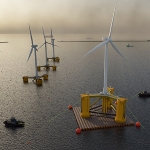
South Korea’s wind energy industry is gaining strategic importance as the country seeks to expand renewable generation, strengthen energy security, and advance its carbon-neutrality goals. With limited land availability and high population density, **offshore wind is emerging as a particularly important growth avenue**.
South Korea’s wind energy industry is gaining strategic importance as the country seeks to expand renewable generation, strengthen energy security, and advance its carbon-neutrality goals. With limited land availability and high population density, **offshore wind is emerging as a particularly important growth avenue**.
### Key Growth Trends
???? Rapid development of offshore wind projects
???? Expansion of fixed-bottom and floating offshore wind technologies
???? Government-led renewable-energy auctions and long-term contracts
???? Increasing investment in ports, transmission, and offshore infrastructure
???? Growing demand for domestic wind-turbine and component supply chains
???? Integration of wind power with battery storage and other flexibility solutions
???? Rising focus on local community participation and project acceptance
### Offshore Wind: A Major Opportunity
South Korea is strengthening its offshore-wind procurement framework. In the first half of 2025, the government announced around **1.25 GW of fixed-bottom offshore wind capacity** through its auction system, including approximately 500 MW allocated to a newly created public-led segment. The framework also places greater emphasis on supply-chain and energy-security considerations.
The country’s offshore wind opportunity is supported by its extensive coastline, while offshore development helps address the constraints created by limited land availability and competing land uses.
### Strategic Market Dynamics
South Korea’s wind-energy expansion will depend not only on project pipelines but also on **grid availability, permitting, financing, supply-chain capacity, technology costs, and community acceptance**. The IEA has emphasized the importance of early stakeholder engagement and stronger spatial planning to reduce delays and improve the development of renewable-energy infrastructure.
### Opportunities Through 2033
The market offers opportunities across **offshore wind development, turbine manufacturing, foundations, subsea cables, vessels, ports, EPC services, grid infrastructure, energy storage, digital monitoring, and operations & maintenance**.
For manufacturers, developers, investors, and technology providers, South Korea’s transition toward a larger renewable-energy system creates a long-term opportunity to participate in one of Asia’s emerging offshore-wind markets.
???? **South Korea Wind Energy Growth Opportunities & Strategic Forecast 2033** provides strategic insights into market drivers, technology trends, competitive dynamics, investment opportunities, challenges, and the long-term outlook for South Korea’s wind-energy industry.
Mexico’s wind energy industry is entering a new phase of expansion, supported by rising electricity demand, national renewable-energy targets, grid investment, and a growing pipeline of clean-energy projects.
Mexico’s wind energy industry is entering a new phase of expansion, supported by rising electricity demand, national renewable-energy targets, grid investment, and a growing pipeline of clean-energy projects.
Wind generation reached **10,020 GWh during the first five months of 2026**, up 3.8% from the same period in 2025 and 87% higher than in 2018, highlighting the sector’s growing contribution to Mexico’s electricity system.
### Key Growth Drivers
???? Expansion of utility-scale wind projects
???? Increasing demand for clean and reliable electricity
???? Government-backed renewable-capacity additions
???? Grid modernization and transmission investment
???? Growing opportunities for hybrid wind-plus-storage projects
???? Rising interest in industrial and corporate clean-energy procurement
???? Development of domestic renewable-energy supply chains
### Strong Project Pipeline
Mexico’s 2025–2030 power-expansion strategy includes substantial renewable investment. The government has announced **2,850 MW of new wind capacity** alongside 5,393 MW of solar PV capacity as part of CFE’s planned additions.
In addition, five private renewable projects selected for development include **849 MW of wind capacity**, with projects spread across multiple Mexican states and paired with significant energy-storage capacity.
### Market Outlook to 2033
Mexico’s broader renewable-energy market is forecast to expand strongly through 2033, with wind remaining an important segment alongside solar, hydropower, and bioenergy.
Growth opportunities are emerging across **wind turbine manufacturing, project development, EPC services, grid infrastructure, energy storage, digital monitoring, operations & maintenance, and hybrid renewable systems**.
The Mexican government’s current renewable-energy expansion plan targets **32 GW of additional power capacity by 2030**, including 22 GW from renewable sources, reinforcing the long-term investment environment for clean-energy technologies.
???? **Mexico Wind Energy Industry Size, Share & Growth Forecast 2033** provides strategic insights into market size, growth drivers, industry trends, competitive dynamics, investment opportunities, challenges, and the future outlook of Mexico’s wind power sector.
Australia's strong renewable energy potential and expanding clean-energy infrastructure are creating significant opportunities for the **wind energy industry**. With large-scale projects, grid development, and growing demand for low-carbon electricity, wind power is becoming an important component of Australia's evolving energy mix.
Australia's strong renewable energy potential and expanding clean-energy infrastructure are creating significant opportunities for the **wind energy industry**. With large-scale projects, grid development, and growing demand for low-carbon electricity, wind power is becoming an important component of Australia's evolving energy mix.
???? **Key Market Growth Drivers**
• Abundant wind resources across key regions
• Expansion of utility-scale wind farms
• Growing demand for renewable electricity
• Increasing investments in transmission and grid infrastructure
• Rising focus on energy transition and emissions reduction
???? **Emerging Opportunities**
Opportunities are expanding across onshore wind, offshore wind, turbine manufacturing and services, project development, operations and maintenance, and grid integration. Advances in turbine technology, digital monitoring, and hybrid renewable projects are also creating new avenues for industry growth.
???? **Revenue Outlook to 2033**
Australia's wind energy market is expected to evolve as renewable generation capacity expands and electricity systems become increasingly integrated with clean-energy technologies. Project investment, grid connectivity, policy developments, technology costs, and power demand will remain important factors influencing industry revenues through 2033.
???? **Explore the Australia Wind Energy Revenue Analysis & Industry Forecast 2033** to understand market dynamics, revenue opportunities, technology trends, regional developments, investment prospects, and the competitive landscape shaping Australia's wind energy industry.
The **wind turbine casting market** is becoming increasingly important as turbine manufacturers move toward larger, more powerful, and highly engineered components. Cast components such as hubs, frames, housings, and other structural parts play a critical role in turbine performance, reliability, and durability.
The **wind turbine casting market** is becoming increasingly important as turbine manufacturers move toward larger, more powerful, and highly engineered components. Cast components such as hubs, frames, housings, and other structural parts play a critical role in turbine performance, reliability, and durability.
???? **What Is Driving the Market?**
• Rapid expansion of global wind power capacity
• Growing demand for larger and higher-capacity turbines
• Increasing offshore wind development
• Need for lightweight, durable, and high-strength cast components
• Advancements in casting processes, materials, and quality control
???? **Competitive Landscape**
Leading participants in the wind turbine casting ecosystem are focusing on production capacity, advanced foundry technologies, precision manufacturing, quality assurance, and long-term partnerships with turbine OEMs. Companies with strong capabilities in large-scale castings and complex components are positioned to benefit from continued turbine deployment.
???? **2026 Market Outlook**
The competitive environment is being shaped by wind turbine technology upgrades, offshore project expansion, manufacturing localization, supply-chain resilience, and demand for increasingly sophisticated components. Strategic capacity investments and manufacturing innovation are likely to remain key differentiators.
???? **Explore the Wind Turbine Casting Market 2026** to assess leading companies, market positioning, technology trends, production capabilities, growth opportunities, regional developments, and the competitive dynamics shaping the industry.
Japan's transition toward a more diversified and sustainable energy mix is creating new opportunities for the **wind energy industry**. With growing interest in offshore wind, advanced turbine technologies, and renewable power integration, wind energy is positioned to play an increasingly important role in Japan's future electricity system.
Japan's transition toward a more diversified and sustainable energy mix is creating new opportunities for the **wind energy industry**. With growing interest in offshore wind, advanced turbine technologies, and renewable power integration, wind energy is positioned to play an increasingly important role in Japan's future electricity system.
???? **Key Growth Drivers**
• Increasing focus on renewable energy development
• Expansion of offshore wind project opportunities
• Rising demand for low-carbon electricity generation
• Technological advances in wind turbines and offshore infrastructure
• Growing investments in grid modernization and renewable integration
???? **Emerging Opportunities**
Offshore wind, floating wind technologies, larger and more efficient turbines, digital monitoring, and specialized marine infrastructure are creating new avenues for industry growth. Improvements in project development, operations, maintenance, and grid connectivity could further strengthen Japan's wind energy ecosystem.
???? **Market Outlook to 2033**
Japan's wind energy sector is expected to evolve alongside renewable-energy targets, infrastructure investment, technology innovation, and offshore project development. Strategic partnerships, supply-chain capabilities, and efficient project execution will remain important for capturing future market opportunities.
???? **Explore the Japan Wind Energy Growth, Trends & Forecast Outlook 2033** to understand market dynamics, technology developments, offshore opportunities, investment trends, regional prospects, and the competitive landscape shaping Japan's wind energy industry.
Introduction
The advanced magnetic materials market has seen significant growth over the past few years, driven by the increasing demand for high-performance materials across various industries ...
Introduction
The advanced magnetic materials market has seen significant growth over the past few years, driven by the increasing demand for high-performance materials across various industries ...
Introduction
As the global transition toward renewable energy accelerates, the demand for innovative solutions to harness wind power continues to grow. Traditional offshore wind turbines, which ...
Introduction
Wind energy has long been regarded as one of the most sustainable and environmentally friendly sources of renewable energy. Over the years, advancements in technology and increasing...